What 5 Stewardship Successes in the Bible Can Teach Us About Money
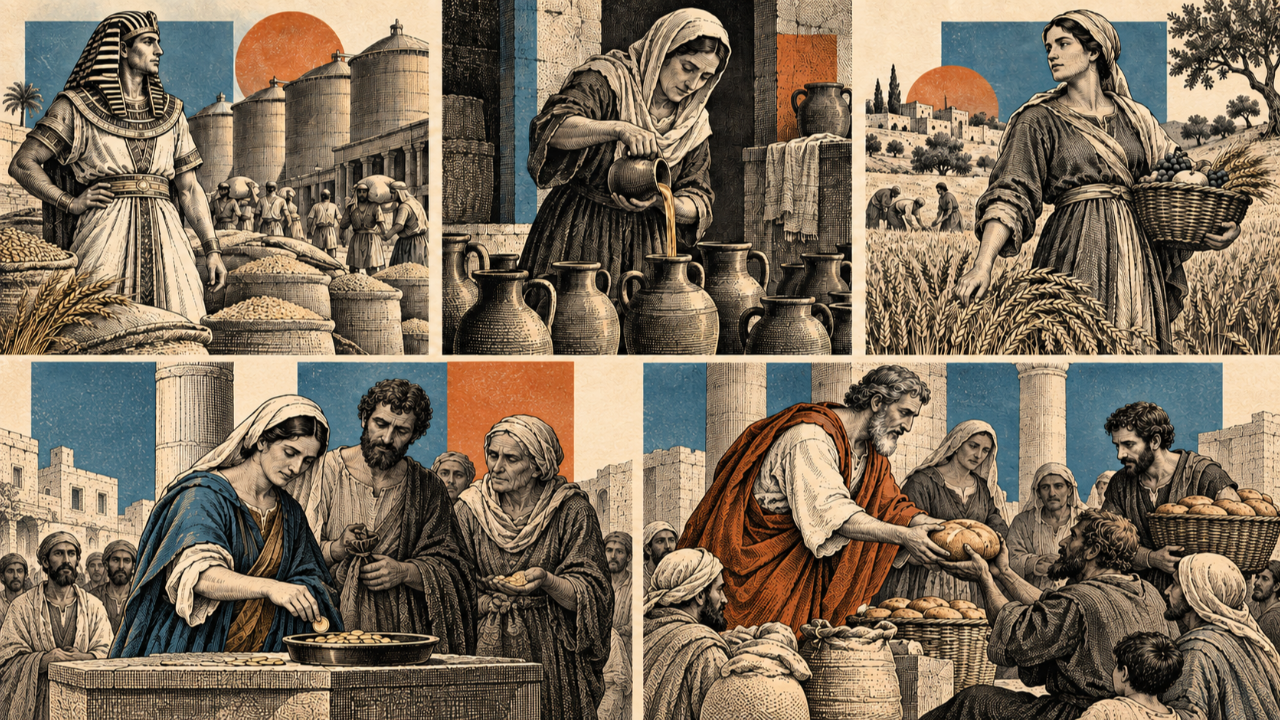
The Bible’s accounts of faithful stewardship take place in settings far removed from modern banking, investing, and household budgets. Yet they address enduring questions: How should people prepare for uncertainty? What responsibilities come with wealth? How do financial choices affect a community? These five examples offer principles for thinking about money within a broader moral framework.
1. Joseph: Preparation is an act of foresight
In Genesis 41, Joseph interprets Pharaoh’s dreams as a warning that seven years of abundance will be followed by seven years of famine. He recommends storing a portion of the harvest during the prosperous years, and Egypt is consequently able to withstand the shortage.
Joseph’s success rests on recognizing that favorable conditions may be temporary. Saving is therefore more than a preference for caution. It can be a way of meeting future responsibilities when resources are available in the present.
2. The widow: Begin with the resources at hand
In 2 Kings 4:1–7, a widow faces a severe debt crisis. When Elisha asks what she has, she identifies a small jar of oil. Through God’s provision, the oil becomes sufficient for her to pay her debts and support her household.
The account describes a miracle, not a predictable method of producing income. Even so, its opening question is instructive. Scarcity can make existing resources easy to overlook. Taking account of what one possesses is a necessary first step toward responding to a financial problem.
3. The Proverbs 31 woman: Stewardship requires discernment
Proverbs 31:10–31 portrays a woman who manages her household, engages in trade, considers a field before purchasing it, and provides for those in her care. Her activity is varied, but the description consistently emphasizes judgment and diligence.
This portrait challenges the idea that stewardship consists only of avoiding waste. Wise use of money may also involve productive work, evaluating opportunities, and making decisions whose benefits extend to others.
4. The Macedonian churches: Generosity is measured by willingness
In 2 Corinthians 8:1–5, Paul describes churches that contributed to a collection despite their own poverty. He emphasizes that they gave willingly and according to their means.
Their example complicates the assumption that generosity begins only after financial security has been achieved. At the same time, Paul’s attention to willingness and means keeps the focus on a considered gift rather than a prescribed amount. Generosity expresses a person’s commitments through the resources available to them.
5. The early church: Resources can serve a common good
Acts 4:32–35 describes believers sharing possessions so that needs within their community could be met. Those with property sometimes sold it and made the proceeds available for distribution.
The passage depicts an early Christian community rather than a universal economic system. Its central concern, however, remains relevant: stewardship has a social dimension. The use of personal resources can affect whether others have what they need.
Taken together, these accounts resist a narrow definition of financial success. They commend preparation, discernment, integrity, generosity, and concern for others. In Scripture, money is never merely a measure of what someone has accumulated. Its use also reveals what that person values.